Why this matters
Almost every big decision a government makes leans on one quiet number: how many people there will be, and of what ages. It decides how many classrooms and teachers the country needs, how big the future workforce and the pension bill will be, how many clinics to build and where. Get the number wrong and you under-build schools for a generation, or you plan a pension system for a population that never arrives.
For The Gambia, that number has only ever come from one place, the United Nations. And the UN's current projection was finished before the country counted itself for the first time in over a decade. So I did something simple. I took the new 2024 census, used the same modelling the UN uses, and worked out the future population myself, in the open, so anyone can check it. This is that second opinion.
The numbers we actually have
Here is the hard part. The Gambia does not have a working system for registering deaths. Most people who die are never recorded, so there is no national record of who dies at what age, year after year. That record is exactly what you need to forecast mortality, and it is the reason The Gambia does not appear in the Human Mortality Database, the dataset researchers normally reach for.
What we do have is a patchwork. The UN publishes reconstructed estimates that fill the gaps. Two long-running research sites, at Farafenni and Basse, have tracked births and deaths in their districts since 1981 and 2007. National surveys measure child deaths fairly well and adult deaths roughly. And every decade or so, a census counts everyone. The honest way to work here is not to hide that thinness behind a single confident figure. It is to build the forecast carefully, say out loud how uncertain each piece is, and carry that uncertainty all the way through to the answer.
A 13% surprise
The first real finding fell out before I forecast anything. The UN puts The Gambia at about 2.73 million people in 2023. The 2024 census counted roughly 2.42 million. That is a gap of around 300,000 people, about 13%, and it runs the same way in every past census too. The UN has consistently sat above the count on the ground.
This is not the UN being careless. Their 2024 estimates were locked in before the census results came out, and they deliberately adjust counts upward for people they think get missed. But the gap is real, and it matters, because if you start a 50-year projection from a number that is already too high, every future year inherits the error. Re-basing the whole thing on the census is the single most important decision in this project.
How Gambians stopped dying young
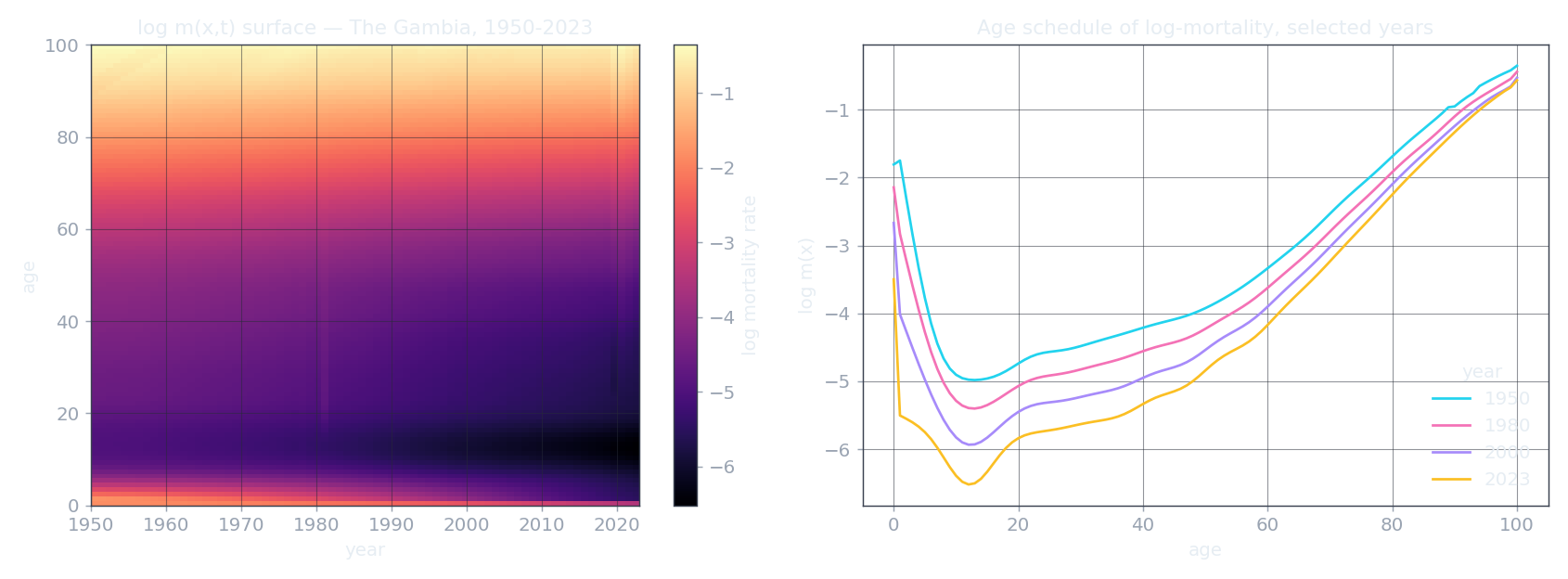
The good news first. Life in The Gambia has gotten dramatically longer. A baby born in 1950 could expect to live about 31 years. By 2023 that was 66. Infant mortality fell by more than four-fifths over the same stretch. The chart below shows the whole picture at once. Every point is the death rate at one age in one year, and the surface steadily lightens, meaning fewer deaths, as the decades pass.
Three ways to guess the future
To project mortality forward I used the Lee-Carter model. It is the workhorse behind the UN's own forecasts, and the idea is intuitive: find the overall trend in how fast death rates are falling, then carry it forward. I built it three ways, each more careful than the last, partly to be thorough and partly to see how much the choice of method actually changes the answer.
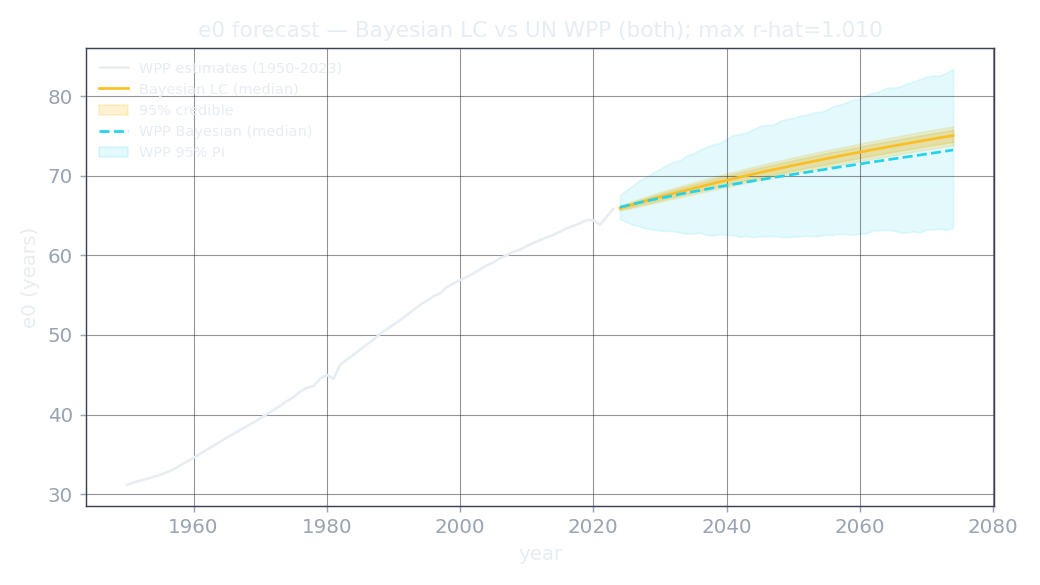
The plain version fits the trend directly. The Bayesian version does the same thing but keeps honest track of everything it is unsure about, using a method called Markov-chain Monte Carlo, so the final forecast comes with a proper range rather than a single line. The third, coherent version forecasts The Gambia alongside seven West-African neighbours at once, so the country cannot quietly drift off to a life expectancy its region has never seen. All three landed in the same place: life expectancy reaching about 75 years by 2074.
They disagreed about one thing, and the disagreement is itself worth reporting. My forecasts all produced a fairly tight range around that 75-year figure. The UN's forecast is much wider. The reason is that the UN's method builds in a kind of structural doubt about how fast mortality can keep improving over half a century, doubt that simple trend-extrapolation, even a careful Bayesian one, does not capture. In plain terms: my models may be a little too confident about the long run, and the UN's wide band is doing real work.
Checking the machine
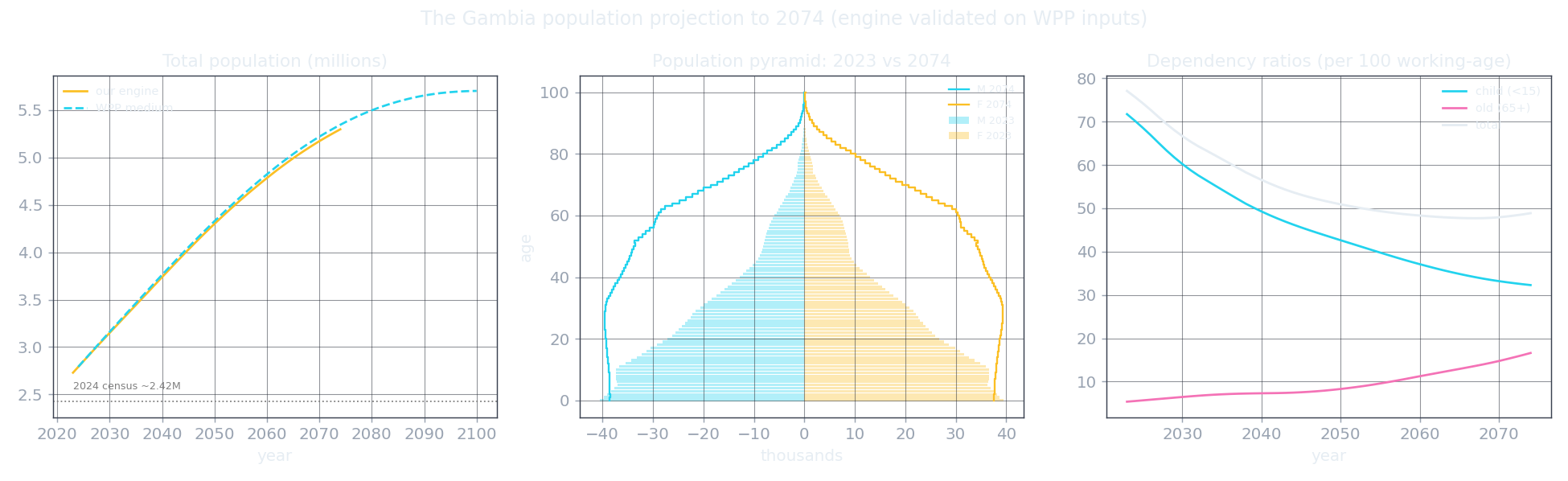
A forecast engine is only worth trusting if it can reproduce an answer we already know. So before I fed it my own inputs, I fed it the UN's, and asked whether it could rebuild the UN's published projection. It did, staying within 1% all the way to 2074. That tells me the population accounting, the part that ages people forward, adds births and subtracts deaths, is sound.
I also tested the mortality model the way you would test any forecast: I trained it only on data up to 2010 and asked it to predict 2011 to 2023, years it had never seen. It was off by about two-thirds of a year on average, and the truth landed inside its range every single year. That is a reassuring track record for something now being asked to look fifty years ahead.
What the projection says
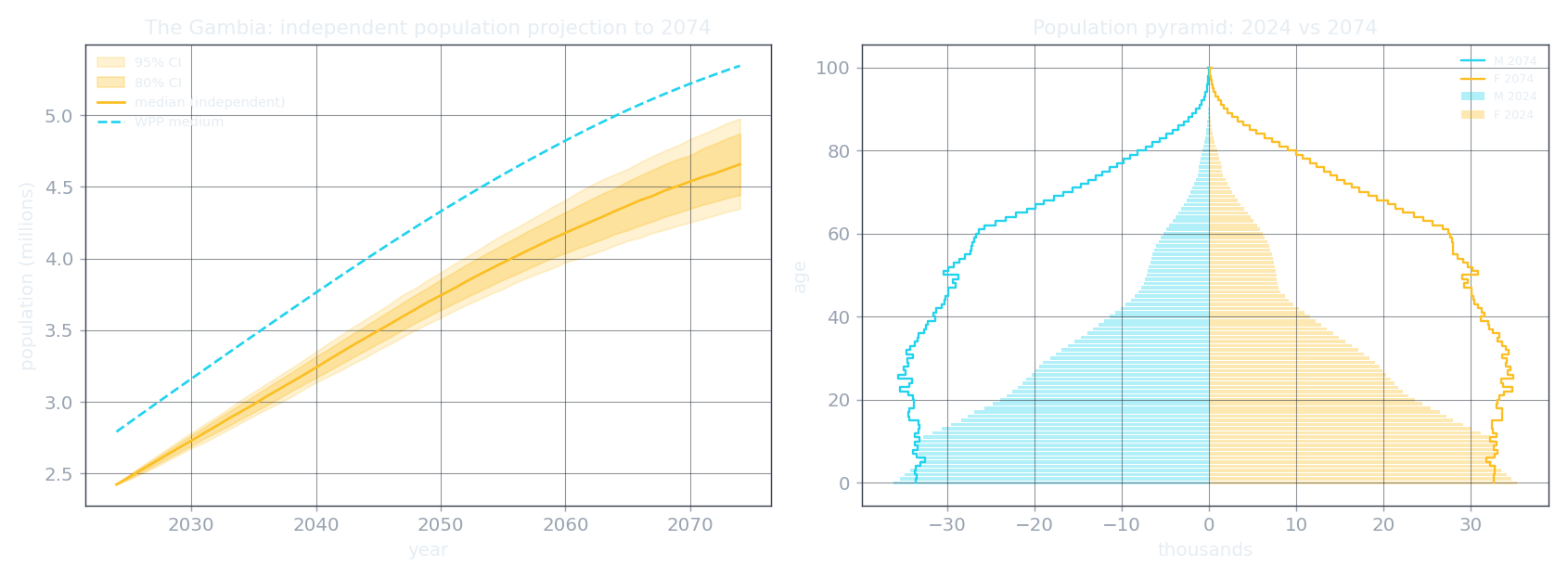
With the engine trusted and the base re-set to the census, I ran the projection a thousand times over, each run drawing a slightly different mortality and fertility future, so the spread of results becomes a real measure of uncertainty. The population reaches about 3.74 million by 2050 and 4.66 million by 2074, with a 95% range of 4.35 to 4.98 million.
Because it starts from the census rather than the UN's higher 2023 figure, it runs about 0.7 million below the UN's own line all the way out. That difference, the size of a decent-sized region, is not a modelling quirk. It is what happens when you take the new count seriously.
The dividend, and the ageing
The most important part of this is not the headcount, it is the shape. Today, for every 100 working-age Gambians there are about 77 dependents, mostly children. By the 2070s that drops to around 49. Economists call the gap that opens up the demographic dividend. It is the same window that lifted South Korea and much of East Asia, when a large, growing working-age population can pull a country up fast. The catch is that it only pays off if those workers find real jobs and real schooling. The window opens on its own. The dividend does not.
At the same time, a quieter shift is coming. The number of Gambians over 65 grows more than sevenfold, from about 73,000 today to roughly 550,000, and their share of the population rises from 3% to about 12%. Measured against the working-age population, old-age dependency roughly triples, from 5 to 18 per 100. The Gambia is young today and will stay young for decades, but it will need pensions and elderly healthcare it has barely begun to build, and the cheapest time to start building them is during the dividend years, while the working population is large and the elderly one is still small.
What I'm not sure about
I would rather be honest than impressive. Every number here comes with a range, not false precision. The biggest open questions are migration, which is volatile for The Gambia and which I handled as a single central scenario, and the fine detail of the new census, which will sharpen the starting point once it is fully published. Two checks are still on my list: comparing the model against the actual life tables from the Farafenni and Basse research sites, and against an independent global reconstruction. Both need data I have to dig out by hand, so I have flagged them openly rather than quietly skipped them.
The bottom line
Working in the open, on public data, with the methods the UN itself trusts, an independent projection puts The Gambia at about 4.7 million people by 2074. That is meaningfully below the figure in circulation today, once the new census is taken into account, and the country is heading into a window of falling dependency that is also the run-up to an ageing society. The most important result was not clever. It came from taking the 2024 census seriously and checking every step before believing it. Any plan still anchored to the older UN numbers is worth a second look.